Every blockbuster trade gets a letter grade within about ninety seconds of the news breaking, and those grades are made of pure vibes — fit, age, draft picks, the general feeling that one front office "won." The problem is that nobody at the time has the one piece of evidence that actually settles it: the production. Win Shares can't be tweeted on trade-deadline day, because the player hasn't played the games yet. But years later the ledger is closed, and we can finally re-grade the deal on what the player actually did instead of what we hoped he'd do.
What a Win Share is, and what it isn't
Win Shares is an attempt to answer a deceptively simple question: how many of this team's wins were this player's production worth? It takes a player's offensive and defensive box-score contributions, compares them to league average, converts them into a points-above-baseline figure, and divides by how many points it takes to buy a win. A full season from a good starter is worth somewhere around seven to ten Win Shares; an MVP campaign can clear fifteen. It's a cumulative stat, which is the whole reason it's useful here — let it run for a decade and it adds up into a single number you can hang a verdict on.
That cumulative, box-score nature is also its blind spot, and it's a big one. Win Shares is weighted toward the regular season because that's where 82 of the games are. It rewards longevity and availability as much as peak greatness — play more, accumulate more. And it has almost nothing to say about a two-week run in June that changes a franchise forever. It's an all-in-one metric, the same family as the ones we break down in the piece on BPM, EPM and the all-in-one stat, and like all of them it prices durability beautifully and transcendence terribly. Keep that in your back pocket; the last trade on this list is built entirely out of it.
Kareem Abdul-Jabbar: the trade that broke the scale
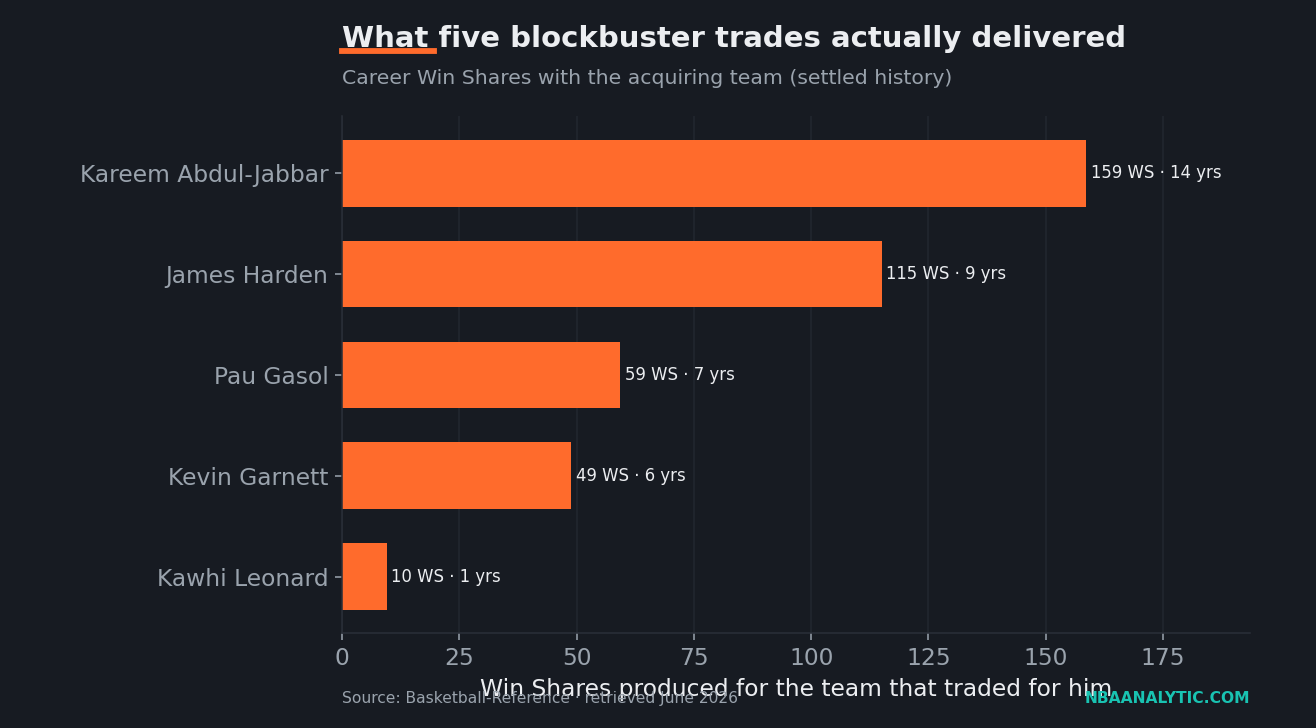
In 1975 the Lakers acquired Kareem Abdul-Jabbar from Milwaukee, and "won the trade" undersells it to the point of comedy. Over the 14 seasons that followed, Abdul-Jabbar produced 158.6 Win Shares for Los Angeles. That is not a typo and it is barely a number a human can feel — it's roughly the entire career output of a very good Hall of Famer, delivered to one team, after the trade. The day-one grade would have been an easy A, and for once the vibes and the ledger agree, except the ledger keeps going long after the applause stopped. Fourteen years of an above-average-to-MVP-level center is what the upper bound of "winning a trade" actually looks like.
James Harden: the modern outlier
In 2012 Oklahoma City sent James Harden to Houston rather than pay him, and the instant verdict was that the Thunder had blinked. The production confirms it without much sympathy: across 9 seasons Harden generated 115.0 Win Shares for the Rockets. He arrived a sixth man and left one of the most valuable offensive engines the box score has ever measured, and the cumulative total reflects nearly a decade of that. Here's the thing the grade-the-day-of crowd missed — there was no championship in Houston for all that production. By the title-banner standard, those nine years "failed." By the Win Shares standard, they're the second-biggest haul on this entire list. That tension is the whole article, and Harden is the warm-up act for it.
Gasol and Garnett: the deals that actually bought rings
The 2008 trade that sent Pau Gasol from Memphis to the Lakers was mocked as a giveaway at the time, and it returned 59.2 Win Shares over 7 seasons — plus two championships, which Win Shares will acknowledge only as the regular-season wins that preceded them. A year earlier Boston acquired Kevin Garnett from Minnesota, who delivered 48.8 Win Shares across 6 seasons and a 2008 title of his own. Both of these are unambiguous wins by any method. But notice the ordering already forming: Garnett, a top-tier defensive anchor on a championship team, sits at the bottom of these four in raw Win Shares purely because six seasons accumulate less than nine or fourteen. The metric isn't wrong. It's just measuring volume of contribution, not the trophy at the end.
Kawhi Leonard: the number that proves the point
And then there's the 2018 deal that sent Kawhi Leonard from San Antonio to Toronto. He produced 9.5 Win Shares over 1 season — the fewest of anyone here by an order of magnitude, a rounding error next to Abdul-Jabbar's 158.6. Run it through Win Shares cold and you'd grade this the worst trade on the page, a single year of a rental who walked in free agency the moment it ended. Win Shares sees nine and a half wins and a goodbye.
What Win Shares cannot see is that those games ended with the only championship in franchise history, delivered by one of the great playoff runs anyone has played. A title is not a regular-season quantity, and a transcendent April-through-June does not fit inside a stat weighted toward the other 82 games. Toronto would make this trade again in a heartbeat, and they'd be right, and the metric would still rank it last. That's not a failure of the trade. It's the precise, useful failure of the tool — Win Shares prices a decade of durable production exactly, and prices a banner at zero.
| Player | Trade (from → to) | Seasons | WS with team |
|---|---|---|---|
| Kareem Abdul-Jabbar | 1975: Milwaukee → Los Angeles Lakers | 14 | 158.6 |
| James Harden | 2012: Oklahoma City → Houston Rockets | 9 | 115.0 |
| Pau Gasol | 2008: Memphis → Los Angeles Lakers | 7 | 59.2 |
| Kevin Garnett | 2007: Minnesota → Boston Celtics | 6 | 48.8 |
| Kawhi Leonard | 2018: San Antonio → Toronto Raptors | 1 | 9.5 |
The takeaway
Win Shares is the best friend a hindsight trade grade has and the worst friend a championship has. It will tell you, correctly, that Abdul-Jabbar's 158.6 was the most productive acquisition on this list and that Harden's 115.0 was the most valuable trade that never won anything. It will also tell you, with a straight face, that Kawhi Leonard's nine and a half wins make Toronto's trade the weakest here — and that's the moment you learn what the number is for and where it stops. Re-grade trades with Win Shares by all means; it's a far better witness than trade-day vibes. Just remember it's testifying about regular-season production, not about the thing teams actually make these trades to get.
Sources & Further Reading
- Win Shares totals and trade details: Basketball-Reference (retrieved June 2026). The pull-and-tabulate script is
trades_win_shares.py. - Win Shares methodology originates with the work of Dean Oliver and Justin Kubatko, as documented in the Basketball-Reference glossary.