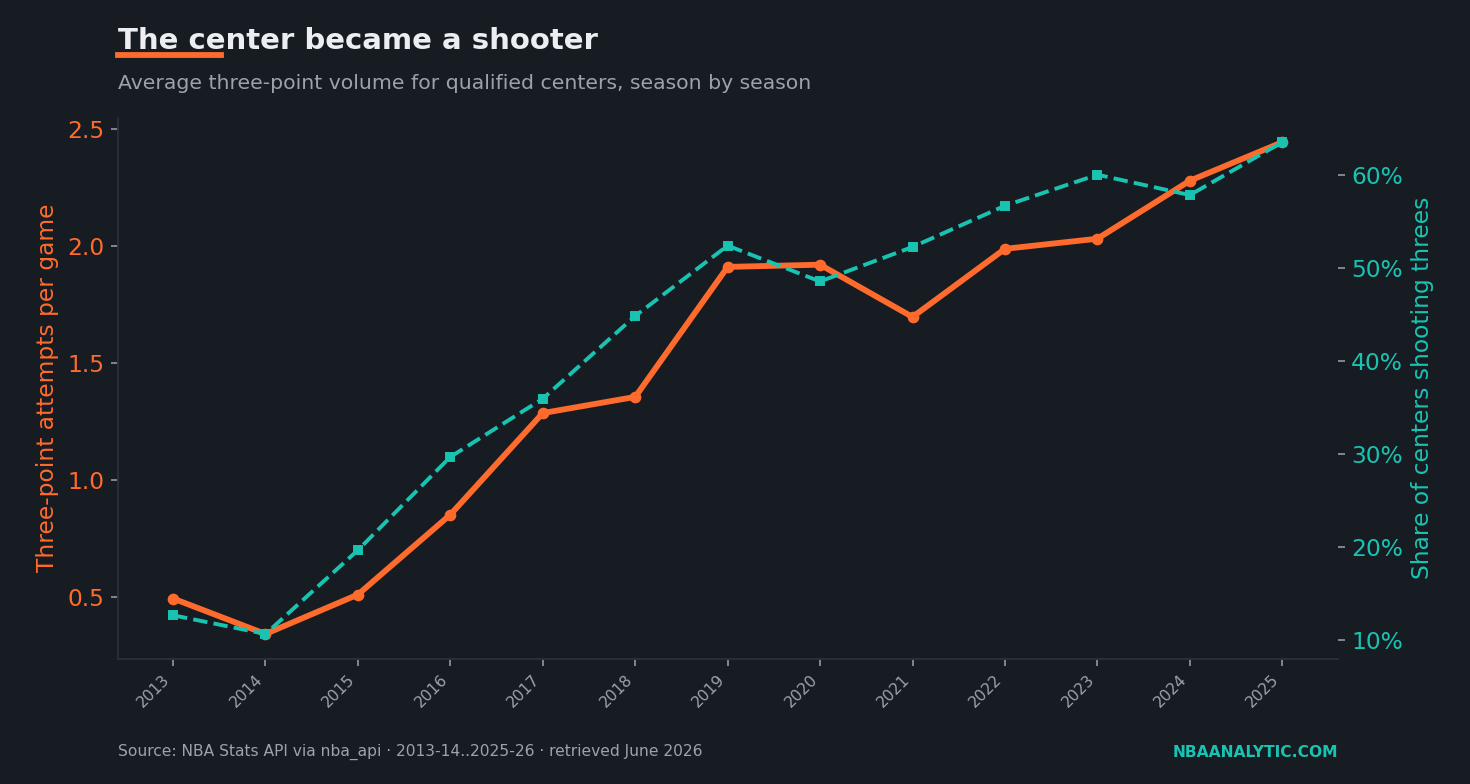
Drop a prime 2013-14 center into a game tonight and he would look like a man who wandered onto the wrong court. Back to the basket, planted on the block, waiting for an entry pass that the offense no longer throws — it would read less like a throwback and more like a misprint. We pulled every qualified center's shooting line from 2013-14 through 2025-26 to watch the position rewrite itself, and the numbers are blunt about it. The average center's three-point attempts went up fivefold, and the back-to-the-basket post-up quietly died on the way.
The fingerprint, in one number
Start with the headline. In 2013-14, the average qualified center attempted 0.49 threes per game — call it one every other night, usually an end-of-quarter accident. By 2025-26 that figure was 2.44, a clean 5.0× increase. Nothing else about the box score moved that violently in a decade. The center didn't add a wrinkle to his game; he swapped the foundation underneath it.
The participation number is even starker, because an average can hide behind a few outlier gunners. So we counted the share of centers taking at least one three a game — a low bar, just "is this a thing you do at all." In 2013-14 it was 12.7%, roughly one big man in eight. By 2025-26 it was 63.5%. The stretch five went from a novelty act to the default setting in ten seasons.
The death of the post-up
What got traded away to make room was the lowest-efficiency staple in the sport: the back-to-the-basket post-up. For a stretch of NBA history the center's job description was to receive the ball on the block, dribble twice, and turn a defender into a problem from twelve feet. The math eventually caught up. A contested fadeaway two is one of the worst shots a possession can produce, and once front offices internalized the three-point revolution, the entry pass stopped coming. The post-up didn't get coached out of the game so much as priced out of it.
You can see the changeover in the early years of the series. The three-point rate barely budged from 2013-14 to 2015-16 — it actually dipped to 0.34 in 2014-15 before recovering — and then the dam broke. By 2016-17 the average center was up to 0.85 attempts with the shooting share at 29.7%, and by 2019-20 the share crossed half the league at 52.4%. That two-season jump in the back half of the 2010s is the post-up's obituary, written in attempt rates.
The stretch five and the pick-and-pop
The replacement for the post-up wasn't a different shot for the center so much as a different gravity. A big man who can hit from twenty-three feet drags his defender out of the paint, and that vacated space is worth more to the offense than the threes themselves. This is the engine of the pick-and-pop: the center sets a screen, the defense has to choose, and a beat later he's catching at the arc with a runway in front of him. The threat is the point. The make is a bonus.
That's why the participation share matters more to us than the raw attempt count. Going from 12.7% to 63.5% of centers being credible from distance means defenses can no longer park a slow-footed rim protector in the lane and ignore him. The floor got wider one big man at a time, and crucially, the league did it without sacrificing accuracy — centers connected at 33.1% from three in 2013-14 and 35.3% in 2025-26, so the extra two attempts a night aren't bricks, they're points.
The center as a passing hub
The shooting story gets most of the headlines, but the quieter shift might be the more important one: the modern center passes. Spacing the floor pulls a big man away from the rim, and the natural place to put him is at the top of the key — the one spot on the court with eyes on every cutter. So the position's assist rate climbed too. The average center handed out 1.36 assists per game in 2013-14; by 2025-26 that was 2.22, with the trend turning up hard in the 2023-24 season at 2.25. The offense stopped running to the center and started running through him.
It's a smaller multiple than the shooting numbers, and it should be — handoffs and high-post reads were never as rare as the corner three. But it reframes the job. The prototype is no longer a finisher who occupies the dunker spot; it's a connector who can shoot you out of a double team and find the cutter when you don't send one. The post-up center was an endpoint. The modern center is a junction.
The decade at milestone seasons
Numbers in a paragraph blur together, so here is the same evolution at four checkpoints, each pulled straight from the season-by-season series:
| Season | 3PA/G | AST/G | % Shooting 3s |
|---|---|---|---|
| 2013-14 | 0.49 | 1.36 | 12.7 |
| 2016-17 | 0.85 | 1.51 | 29.7 |
| 2019-20 | 1.91 | 1.86 | 52.4 |
| 2022-23 | 1.99 | 1.98 | 56.7 |
| 2025-26 | 2.44 | 2.22 | 63.5 |
Read the columns top to bottom and the slope tells the story better than we can. Every number moves the same direction, and the steepest climb in all three lands between 2016-17 and 2019-20 — the seasons the stretch five stopped being a curiosity. After that the trend flattens but never reverses, which is its own kind of evidence: this wasn't a fad that crested, it was a position settling into a new shape.
The takeaway
The center who anchored a 2013-14 offense wasn't bad at his job — he was excellent at a job the league deleted. In one decade the position's three-point volume quintupled, the share of centers who shoot from range went from one-in-eight to two-in-three, and the assist rate crept up alongside it as the big man drifted from the block to the top of the key. That's not a player getting better. That's a role being rebuilt around what the math always rewarded: spacing, passing, and shots worth more than two points. The post-up center is a museum piece now, and the numbers stopped pretending otherwise years ago.
Sources & Further Reading
- Center shooting and playmaking data: NBA.com/stats, pulled via the nba_api Python package (2013-14 through 2025-26, retrieved June 2026). The collection and aggregation script is
modern_center_evolution.py. - Stat definitions and positional context: Basketball-Reference Glossary.