"Live by the three, die by the three" gets thrown around like a moral lesson — as if a team that shoots a lot of threes is doing something reckless or unserious. It isn't. The cliché is pointing, clumsily, at something real, but the real thing isn't a character flaw. It's variance. A three is worth fifty percent more than a two and goes in far less often, which means a hot or cold shooting night swings the scoreboard harder than it ever did in the mid-range era. A three-heavy league is, mathematically, a higher-variance league — and understanding that is the difference between blaming a loss on "settling for jumpers" and seeing it for what it usually is: noise.
Why threes add variance
The deep math is simple once you separate two ideas: expected value (how many points a shot is worth on average) and variance (how much the result bounces around that average). The three-point revolution, which we covered in pace and space, was won on expected value — a three is the more valuable shot whenever its accuracy clears two-thirds of two-point accuracy. But the same shot that wins on average is also the one that scatters. A shot that converts a little better than a third of the time is, by its nature, an unreliable individual event; you cannot predict any single one. You can only predict the average over a large pile of them.
Compare it to a layup that goes in roughly two-thirds of the time. The layup is close to a sure thing on a possession-by-possession basis — its outcome is rarely surprising. A three is a coin-ish flip weighted toward "miss," worth more when it lands precisely because it lands less often. Stack a team's offense full of those, and the game-to-game point total inherits all that bounce. The more of your scoring rides on shots with low make-rates and high reward, the wider the range of plausible outcomes on any given night.
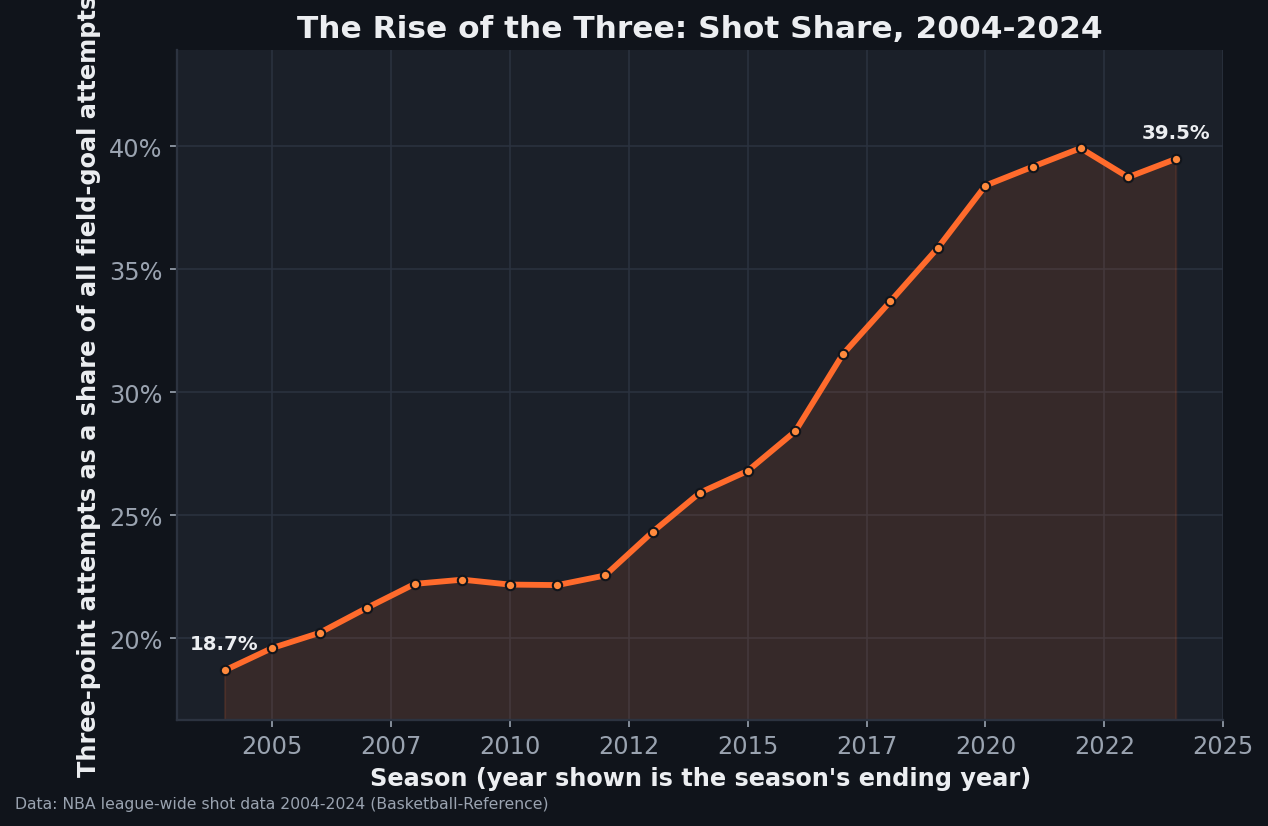
And the league has stacked its offense with exactly those shots. The share of all attempts that are threes has roughly doubled over two decades — which means the variance-heavy shot now drives a far larger slice of every team's scoring than it used to:
The arithmetic of a swing
Numbers make this concrete. The following is a clearly-labeled hypothetical to show the arithmetic — these are not real team figures. Picture a team that, on average, takes 40 threes a night and makes 36% of them. That's 14.4 makes for 43.2 points from distance on a typical evening. Now let the percentage wobble by a few points in each direction — exactly the kind of swing that happens constantly from one game to the next, driven by nothing more than whether open looks happen to fall.
| Night | 3P% on 40 attempts | Makes | Points from three |
|---|---|---|---|
| Cold | 30% | 12 | 36 |
| Average | 36% | 14.4 | 43.2 |
| Hot | 42% | 16.8 | 50.4 |
A six-percentage-point swing in each direction — utterly routine — moves the team between roughly 36 and 50 points from beyond the arc. That's a fourteen-point spread created by shooting alone, on the same number of the same shots, with the offense doing nothing differently. Run the same exercise on a mid-range-heavy team taking long twos at 42% and the swing is smaller, because each made shot is worth a third less. The three doesn't just raise your ceiling; it widens the whole distribution. The points you gain on a hot night are exactly the points you bleed on a cold one.
One game vs. one season
Here's the part that matters for how you watch basketball. Variance and skill resolve on completely different timescales. Over a full 82-game season, the noise washes out: a team that generates more and better shots will make more of them in the aggregate, and the standings reward the volume of good looks, not any one night's luck. Process wins the long run, almost by definition. The law of averages is patient and undefeated.
A single game is the opposite. One game is a tiny sample, and in a tiny sample the noise can swamp the signal entirely. The better team can generate the better shots all night and still lose because the ball didn't cooperate on a dozen open looks — looks that would have fallen at the expected rate over a month and simply didn't over forty-eight minutes. This is why a three-heavy league makes any single game less predictable than it used to be, and why the playoffs, decided in short best-of-seven bursts rather than an 82-game grind, carry so much more shooting noise. A cold shooting night in April can end a season that 82 games said was excellent. That's not a flaw in the team. It's the tax you pay for the most efficient shot in basketball being a high-variance one.
The cliché, examined honestly
So "live by the three, die by the three" is half-right in the worst way. The phrase is usually deployed as a verdict — a team lost shooting threes, therefore relying on threes was a mistake. But the same offense that "died by the three" on Tuesday "lived by it" on Saturday, and the underlying strategy never changed. What changed was the bounce. Judging a process by a single noisy outcome is exactly the error variance is designed to warn you about. A team that takes good threes will lose some games it deserved to win and steal some it deserved to lose; over a season, the good process surfaces. The cliché mistakes a feature of the math for a failure of nerve.
The honest version isn't moral, it's statistical: a three-heavy team accepts a wider range of single-game outcomes in exchange for a higher long-run average. If you're built to win on volume of efficient shots, the cold nights are not evidence you were wrong — they're the price of admission, paid back with interest across a season.
Separating process from luck
This is where modern analysis earns its keep, by refusing to grade a team on results alone. The key move is to separate shot quality — the process, the kind of looks an offense generates — from shooting luck — the results, whether those looks happened to fall. The framing that does this is "made versus expected." Using the location, the defender distance, and the type of every attempt, you can estimate how many points a team would be expected to score on the shots it took, then compare that to what it actually made. A team making well above expectation is shooting hot and probably can't sustain it; a team well below is shooting cold and is likely better than its scoreboard. The shots taken — the process — are far stickier game to game than the makes, which is precisely why analysts trust shot quality over a single night's shooting percentage.
That same instinct underlies true shooting percentage, which folds threes, twos, and free throws into one honest efficiency number — but even true shooting is a results stat, and over a short stretch it inherits all the variance we've been describing. The discipline is to ask, before crowning or burying anyone: was that the process, or was that the bounce?
The takeaway
The three-point era didn't just make the league more efficient; it made it noisier, and the two are inseparable. The most valuable shot in basketball is also a high-variance one, so single games — playoff games most of all — now carry more shooting luck than they used to, even as volume of good shots still wins the season. Read a blowout or an upset through that lens and "live by the three, die by the three" stops sounding like wisdom and starts sounding like what it is: a description of variance, mistaken for a moral.
Sources & Further Reading
- Shot-type and shooting data: NBA.com/stats.
- Shot-quality and expected-points frameworks: PBP Stats and Cleaning the Glass.
- Efficiency and shooting definitions: Basketball-Reference Glossary.