"Clutch" used to be an argument you could never win, because nobody could agree on what counted. Then the NBA went and defined it: the last five minutes of a game with the score within five points. Once there's a stopwatch and a margin, "clutch" stops being a vibe and becomes a column you can pull, sort, and correlate. So we pulled it — every qualified high-volume player from 2025-26 — and asked the only question that matters: is clutch shooting a real, stable, separable skill, or is it just regular shooting wearing a cape?
Now that we can measure it
The beauty of the league's official definition is that it removes the wiggle room. No more "well, that was a meaningful possession." Either there were five minutes or fewer on the clock and the game was within five, or there weren't. Everything we're about to show comes from filtering the play-by-play to exactly that window for the 45 players who took enough clutch shots to bother analyzing. Below that threshold you're not measuring a skill, you're measuring a coin.
That sample-size caveat is going to come up a lot, so plant a flag on it now. A full NBA season is a big number. The clutch slice of a season is a small one — a few dozen shots per player, sometimes fewer. Small samples are where narratives go to be born, because random noise looks exactly like meaningful signal until you ask it for more data.
The correlation that deflates everything
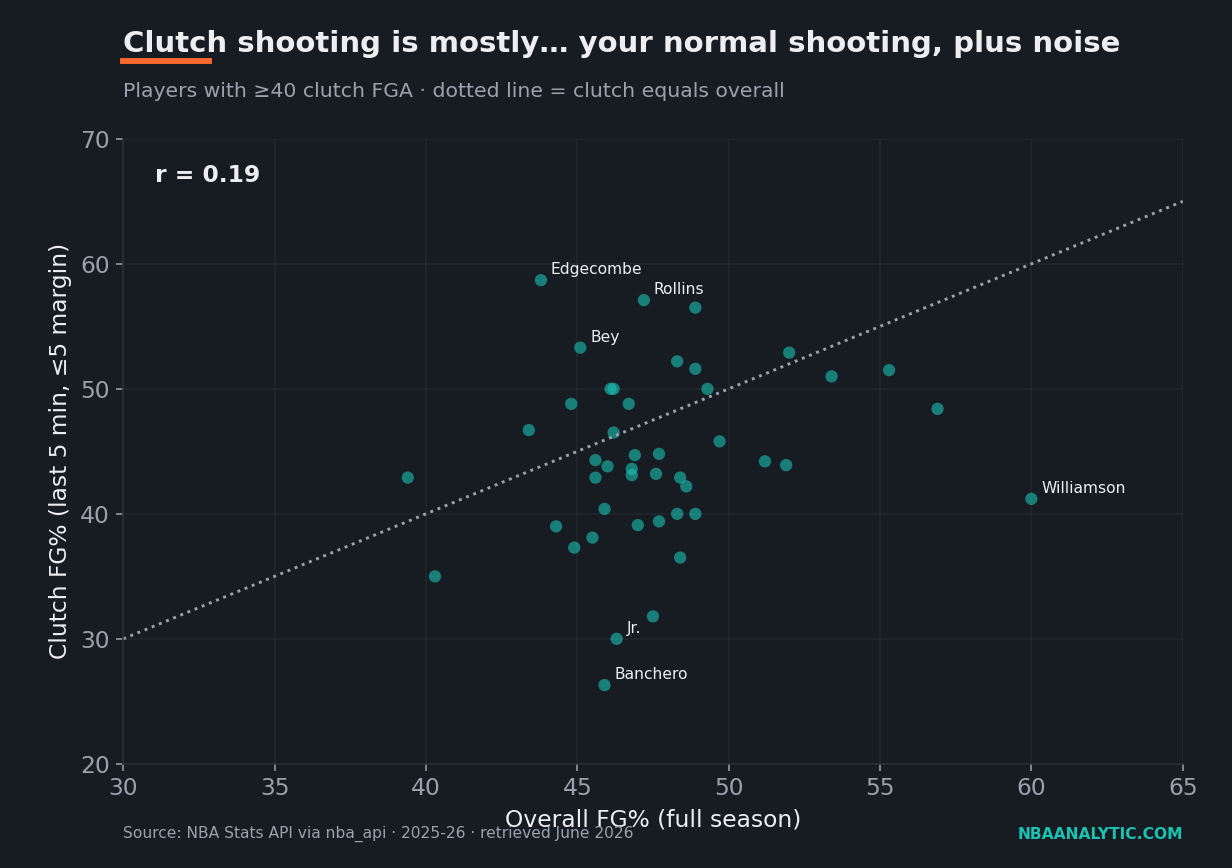
Here's the finding that reframes the entire debate. Across those 45 qualified players, the correlation between a player's clutch field goal percentage and his overall field goal percentage is just 0.192. That is weak. A correlation of 1.0 would mean clutch shooting is perfectly predicted by normal shooting; a correlation of 0 would mean the two have nothing to do with each other. We landed much closer to nothing than to everything — but not because clutch is a separate talent. It's because the clutch numbers are so noisy that they barely track anything, including the player's own established ability.
And when you look at the average difference between clutch and overall FG%, it's -3.2 percentage points. Essentially zero, with a faint negative lean — players shoot a hair worse in the clutch, which makes sense once you remember the defense is set, the help is honest, and nobody's leaking out in transition. There's no leaguewide "clutch gene" lighting players up at the end. If anything, the floor gets slightly harder for everyone at once.
The tails are where reputations are forged
Now for the fun part, and the trap. When you sort players by how much better or worse they shot in the clutch, the extremes look spectacular — and they are almost entirely an artifact of the tiny sample.
The "risers" are led by VJ Edgecombe, who shot 43.8% overall but a blistering 58.7% in the clutch, a jump of nearly fifteen points. Ryan Rollins (47.2% to 57.1%) and Saddiq Bey (45.1% to 53.3%) follow. The "fallers" are just as dramatic in the other direction: Paolo Banchero cratered from 45.9% overall to 26.3% in the clutch, a 19.6-point collapse; Zion Williamson fell from a monster 60.0% to 41.2%; Michael Porter Jr. dropped from 46.3% to 30.0%.
Read those names and your brain immediately writes a story — Edgecombe is ice in his veins, Banchero shrinks under pressure. Resist it. These are the loudest swings precisely because they sit on the fewest shots, and the smallest samples produce the biggest deltas in both directions by pure arithmetic. Take Zion's clutch line at face value and you'd conclude one of the most efficient finishers in basketball forgets how to score in close games, which is not a thing that is true. The tails aren't a leaderboard of character. They're a demonstration of variance.
Real effects exist — they're just small
None of this means clutch performance is pure fiction. There are genuine forces at the end of close games. Legs are tired, so lift on jumpers fades. Defenses tighten, switch more, and stop conceding the easy looks that pad a stat line in the first quarter. The free-throw line turns into its own psychological event, where a player's mechanics don't change but the consequence of each shot does. These are real. They're also small — small enough to be buried under the noise of a 40-shot sample, which is exactly why the leaguewide delta sits near zero and the correlation stays weak. The signal is there; it's just quiet, and reputation is loud. "He's clutch" almost always outruns the evidence, because we remember the one shot that won a game and quietly forget the three that didn't. If you want to see how much a single late possession actually moves the needle, the math behind win probability models is a useful reality check on which moments deserve the mythology.
Who actually shows up in the clutch
So, to be fair to the players who genuinely deliver, because "clutch isn't a separate skill" is not the same as "nobody produces when it counts." Some players simply take and make a huge share of their team's most important shots, and that volume is its own kind of value — somebody has to want the ball at the end, and these guys do.
| Player | Clutch PTS | Clutch FGA | Clutch FG% |
|---|---|---|---|
| Shai Gilgeous-Alexander | 175 | 101 | 51.5 |
| Jamal Murray | 166 | 92 | 52.2 |
| Nikola Jokić | 155 | 93 | 48.4 |
| Kevin Durant | 146 | 87 | 52.9 |
| Tyrese Maxey | 144 | 99 | 46.5 |
| Anthony Edwards | 135 | 85 | 56.5 |
| Cade Cunningham | 121 | 78 | 50.0 |
| Jalen Brunson | 116 | 82 | 48.8 |
Here's the crucial distinction, though: scoring a lot in the clutch is not the same as being more efficient than usual in the clutch. Anthony Edwards posting 56.5% on 85 attempts is excellent, but it's roughly the kind of shooting you'd expect from him anyway — he's not transforming, he's just taking the shots. Tyrese Maxey at 46.5% is carrying real late-game volume at a perfectly ordinary clip. What this table measures is willingness and opportunity, the courage to keep firing when the margin is thin. That's a genuine and valuable trait. It is just a different trait from "becomes a better shooter under pressure," which, leaguewide, barely exists.
The takeaway
Clutch is finally measurable, and measuring it mostly dissolves the myth. A player's clutch shooting is, to a first approximation, his normal shooting with a thick layer of small-sample noise painted on top — the correlation to overall FG% is a weak 0.192, the average delta is a near-zero -3.2 points, and the gaudy risers and fallers are variance cosplaying as destiny. The honest version of "is he clutch?" is "does he take and make a meaningful share of his team's biggest shots?" — and for that, the volume scorers above earn their reputations. Just don't hand anyone a separate, magical efficiency they don't actually have. The clock changes the stakes. It doesn't change the shooter nearly as much as we'd like to believe.
Sources & Further Reading
- Clutch and player data: NBA.com/stats, pulled via the nba_api Python package (2025-26, retrieved June 2026). The analysis script is
clutch_quantified.py. - The official clutch definition (last 5 minutes, score within 5 points) is the NBA's own, documented in the stats glossary at NBA.com/stats.