Six NBA teams will open 2026-27 with a new head coach, and every one of those hires was justified, somewhere, by a win-loss record. Here is the problem with that: a coach's W-L line is mostly the franchise's state wearing the coach's name. The evidence is sitting in this summer's news. Mike Brown — fired four times, no playoff series won as a head coach since 2012 — just took the Knicks to their first title since 1973, in his first season, eighteen months after Sacramento let him go. Same coach, different inheritance, opposite ledger. So instead of reading totals, read shapes. We pulled the season-by-season records for three franchises whose benches carry three very different bets into 2026-27 — Oklahoma City, the Lakers, and Dallas — and the shapes say more than any career percentage. Two of the three inheritances, it turns out, were exactly .500. What happened next was not.
The rule for picking three
To keep this from being favoritism dressed as analysis, the three spotlights follow a rule: one completed arc (the longest-tenured coach among 2026-27's contenders with a full rebuild cycle on his ledger — Mark Daigneault, entering year seven in Oklahoma City), one proof year (a coach in year three, extended but not yet past the second round — JJ Redick, Lakers), and one day zero (the steepest inheritance handed to any of this summer's six new hires — Dusty May, Dallas). The six-team 2026 carousel, for the record: Milwaukee (Taylor Jenkins), Portland (Micah Nori), Chicago (Tiago Splitter), New Orleans (Jamahl Mosley), Orlando (Sean Sweeney), and Dallas — per NBA.com's coaching tracker and ESPN's carousel coverage. Every record below is parsed straight from each franchise's Basketball-Reference season table; the builder script and its 66 asserts are linked at the bottom.
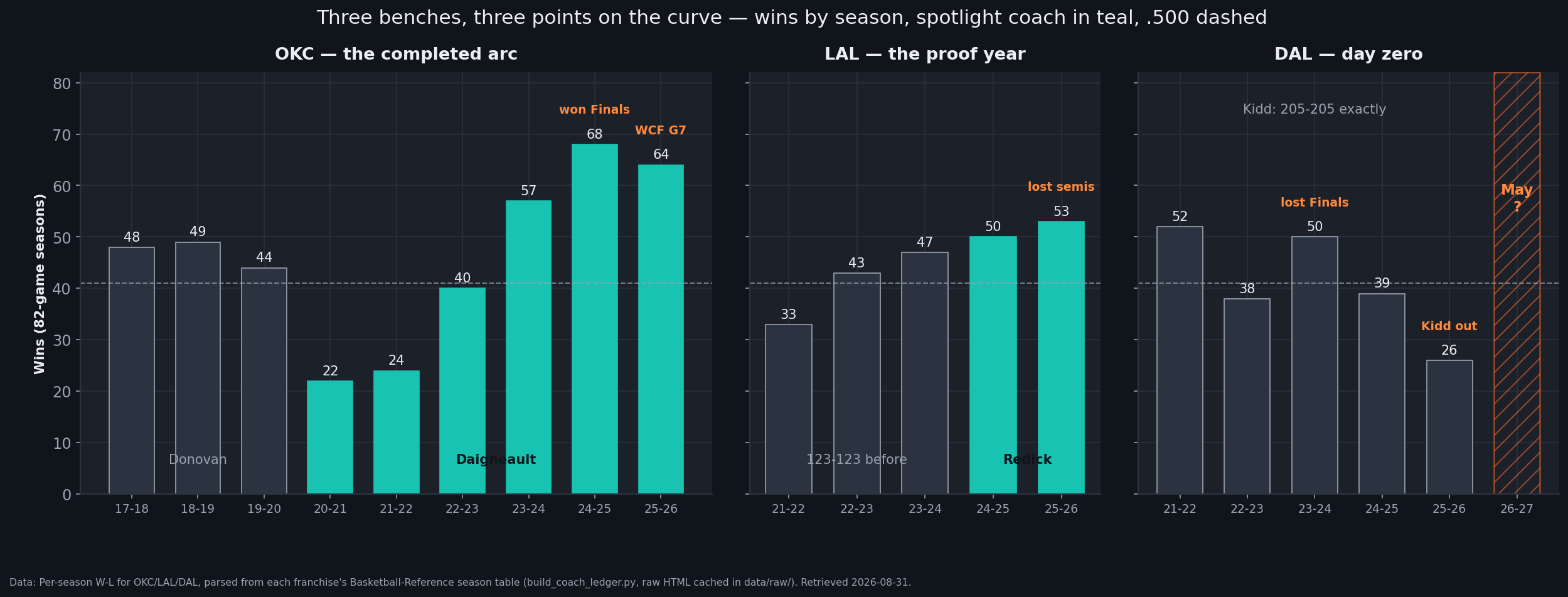
build_coach_ledger.py (raw HTML cached in data/raw/, retrieved 2026-08-31). Charted and verified by chart_coach_ledger.py — 66 asserts.Oklahoma City: the arc you can only see finished
Billy Donovan's last three Thunder seasons were 48-34, 49-33, 44-28 — a .597 team, and a first-round exit all three years. That is the inheritance Mark Daigneault took over in November 2020, at 35, promoted from the team's G League bench when the franchise chose demolition. His first two seasons: 22-50 and 24-58, a combined 46-108 (.299). A coach whose ledger you read as a total would have been fired into the sun. Read as a shape, those two seasons were the plan working — and what followed is the cleanest rebuild curve in the sport: 40-42, 57-25, 68-14, 64-18. The 68-win season ended in the 2025 championship; the 64-win season ended this May in a Game 7 conference-finals loss to Wembanyama's Spurs after holding a 3-2 series lead, with Jalen Williams and Ajay Mitchell hurt. Daigneault's tenure total — 275-207, .570 — is almost exactly Donovan's .597 standing still. The difference is that Donovan's number was a flat line and Daigneault's is a U with a banner at the far end: his last three seasons alone are 189-57 (.768), and the 22-win floor and 68-win peak are the same project, six years apart.
The Lakers: what +10.5 wins a year looks like
The three Laker seasons before JJ Redick — one under Frank Vogel, two under Darvin Ham — went 33-49, 43-39, 47-35: 123-123, exactly .500. Redick's two: 50-32 and 53-29, 103-61 (.628). His first season beat every season of the inheritance; his second beat his first, and the playoff line moved a round, from a first-round exit to a semifinal — a 4-2 win over Houston before Oklahoma City swept the floor with them, part of that 64-win machine above. The per-season arithmetic is the worked example this site always wants: the inheritance averaged 41.0 wins, Redick's tenure averages 51.5 — +10.5 wins per season, sustained for two years, with a contract extension banked before year two and a seventh-place finish in 2025-26 Coach of the Year voting. Now the honest asterisk, and it is a big one: Luka Dončić arrived from Dallas midway through Redick's first season. The ledger cannot separate what Redick built from what the front office handed him — that is this article's whole thesis pointed at its own middle panel. The proof-year framing survives anyway, because the thing year three must prove is exactly the thing the sweep exposed: whether 53 wins is a ceiling or a floor.
Dallas: two .500s that could not be less alike
Jason Kidd's five Dallas seasons add to 205-205. Exactly .500 — the same headline number as the Lakers' inheritance, and a completely different object, because the shape is a falling knife: 52-30 and a conference-finals run, 38-44, 50-32 and the 2024 Finals, then the franchise traded Dončić to Los Angeles in February 2025, and the ledger reads 39-43, 26-56. General manager Nico Harrison, who made the trade, was fired in November 2025; Masai Ujiri arrived as president of basketball operations this spring; Kidd and the team parted ways on May 19, with Ujiri citing "a new direction"; and per ESPN and NBA.com, Dallas handed the empty slot in June to Dusty May, 49, weeks after his Michigan team went 34-3 and beat UConn for the program's first NCAA title since 1989. May's NBA ledger is a hatched rectangle — he has coached zero NBA games, at any level, and his inheritance is the steepest of the summer: a 26-win roster, a new front office, and a fanbase that watched a Finals team become a lottery team in 24 months. Day zero is the only point on the curve where the W-L column is guaranteed honest, because it is empty.
Reading the same number three ways
Put the three ledgers side by side and the totals actively mislead. Donovan's .597 in Oklahoma City was a ceiling — three tries, three first-round exits, no direction. The Lakers' 123-123 was a flat line waiting for a catalyst. Kidd's 205-205 is a Finals banner and a demolition averaged together. And Daigneault's .570 — the lowest career mark of the three sitting coaches in this piece if you exclude his last three seasons — contains both the worst basketball any of these teams played (on purpose) and a championship. The same arithmetic that makes a March blowout worth less than a November one applies to careers: when you know why the losses happened and when they cluster, the number stops being a grade and becomes a story. If preseason expectations interest you more than retrospectives, the preseason-prediction piece covers how little October consensus knows; the short version relevant here is that arcs beat snapshots.
What this doesn't prove
Four limits, stated plainly. First, coach W-L conflates the coach with the roster, the front office, and the training room — Mike Brown's title and Redick's Dončić windfall are the same lesson from opposite directions, and nothing in a season table isolates coaching skill. Second, nothing here measures the coach's actual craft — rotations, timeouts, after-timeout plays, development minutes. Those need play-by-play and lineup data this site's bundled files don't carry, so this piece deliberately claims nothing about them. Third, two seasons (Redick) is a small sample and zero seasons (May) is no sample; the day-zero panel is context, not projection. Fourth, Basketball-Reference attributes seasons to coaches as listed in its franchise tables — mid-season changes appear there with split records, though none of the nineteen team-seasons used here required a split. The picks themselves followed the stated rule, but three case studies are an illustration, not a census of thirty benches.
Reproduce it
Two build-side scripts, no hand-typed numbers. build_coach_ledger.py fetches the three franchise pages from Basketball-Reference (raw HTML cached in data/raw/br_teams_*.html, retrieved 2026-08-31), parses the season tables, and writes coach_ledger.csv, bundled with this site at /data/data_layer/ — nineteen team-seasons with wins, losses, playoff result, and coach attribution. chart_coach_ledger.py recomputes every number quoted above — every season record, the 141-95 and 123-123 and 205-205 and 275-207 aggregates, the +10.5, the playoff-round strings — and pins each with an assert, 66 in all, before drawing the exhibit. The coaching-change facts (hire and exit dates, the Ujiri quote, the carousel list) are from NBA.com, ESPN, and the Thunder's announcement of the Daigneault hire, as of August 31, 2026.
What to watch, one line per bench. Oklahoma City: whether 189-57 over three years has a fourth year in it, and what a completed arc does for an encore after the Game 7 that spoiled the repeat. Los Angeles: whether year three moves the playoff line again, which is the only column of Redick's ledger still flat. Dallas: nothing — literally nothing is on the ledger yet, which is the one honest thing a win-loss record can say about a coaching hire. Ask again in April when the improbable seasons sort themselves out.