This site has spent three articles surveying the three-point line: the corner's premium over the above-the-break three came out at 2.6 percentage points, and the wing piece found the biggest within-arc gap on the site's books — corner over top of the key — at 4.0. All that cartography at the arc, and the largest efficiency cliff on an NBA floor was sitting somewhere else the whole time. The shot file splits the paint in two: the restricted area, the 4-foot half-circle under the basket, and everything else inside the lane. The first zone shot 65.8%. The second shot 44.2%. That is a 21.6-point drop across a boundary a player can step over — five times the biggest gap ever measured at the arc.
The two paints
The file tags 12,350 of its 25,000 attempts — 49.4% of every shot in the sample — as paint shots, split by BASIC_ZONE:
| Zone | Attempts | FG% | ±1 SE | Points per shot | Mean distance |
|---|---|---|---|---|---|
| Restricted area (within 4 ft) | 7,379 | 65.8% | 0.6 | 1.32 | 1.9 ft |
| In the paint, non-RA | 4,971 | 44.2% | 0.7 | 0.88 | 7.8 ft |
The gap is +21.57 points with a standard error of 0.90 — 24 standard errors from zero. The house rule on this site calls anything under 2 SE noise and 2–3 SE a finding; this is not a finding so much as a geological feature. Both zone lines reproduce, to the decimal, the ledger in where the NBA actually shoots from (65.8% and 1.32, 44.2% and 0.88). That piece owns the attempt-share story; the detail borrowed here is that the non-RA paint is the league's third-largest zone at 19.9% of attempts, ahead of the mid-range's 11.1%. This piece is about what those attempts pay, and where exactly the paying stops.
Walking down the cliff, foot by foot
A two-zone comparison locates nothing — the zones average shots taken almost six feet apart. To find the cliff's face, bin every shot by integer distance and walk out from the rim one foot at a time:
| Distance | Zone tag | Attempts | FG% | ±1 SE | Points per shot |
|---|---|---|---|---|---|
| 0 ft | RA | 1,811 | 76.5% | 1.0 | 1.53 |
| 1 ft | RA | 2,164 | 72.5% | 1.0 | 1.45 |
| 2 ft | RA | 1,977 | 59.9% | 1.1 | 1.20 |
| 3 ft | RA | 1,427 | 50.1% | 1.3 | 1.00 |
| 4 ft | non-RA | 909 | 45.5% | 1.7 | 0.91 |
| 5 ft | non-RA | 798 | 41.1% | 1.7 | 0.82 |
| 6 ft | non-RA | 692 | 43.4% | 1.9 | 0.87 |
| 7 ft | non-RA | 577 | 43.8% | 2.1 | 0.88 |
| 8 ft | non-RA | 516 | 39.0% | 2.2 | 0.78 |
| 9 ft | non-RA | 460 | 47.8% | 2.3 | 0.96 |
| 10 ft | non-RA | 426 | 45.3% | 2.4 | 0.91 |
| 11 ft | non-RA | 471 | 45.6% | 2.3 | 0.91 |
| 12 ft | non-RA | 425 | 41.6% | 2.4 | 0.83 |
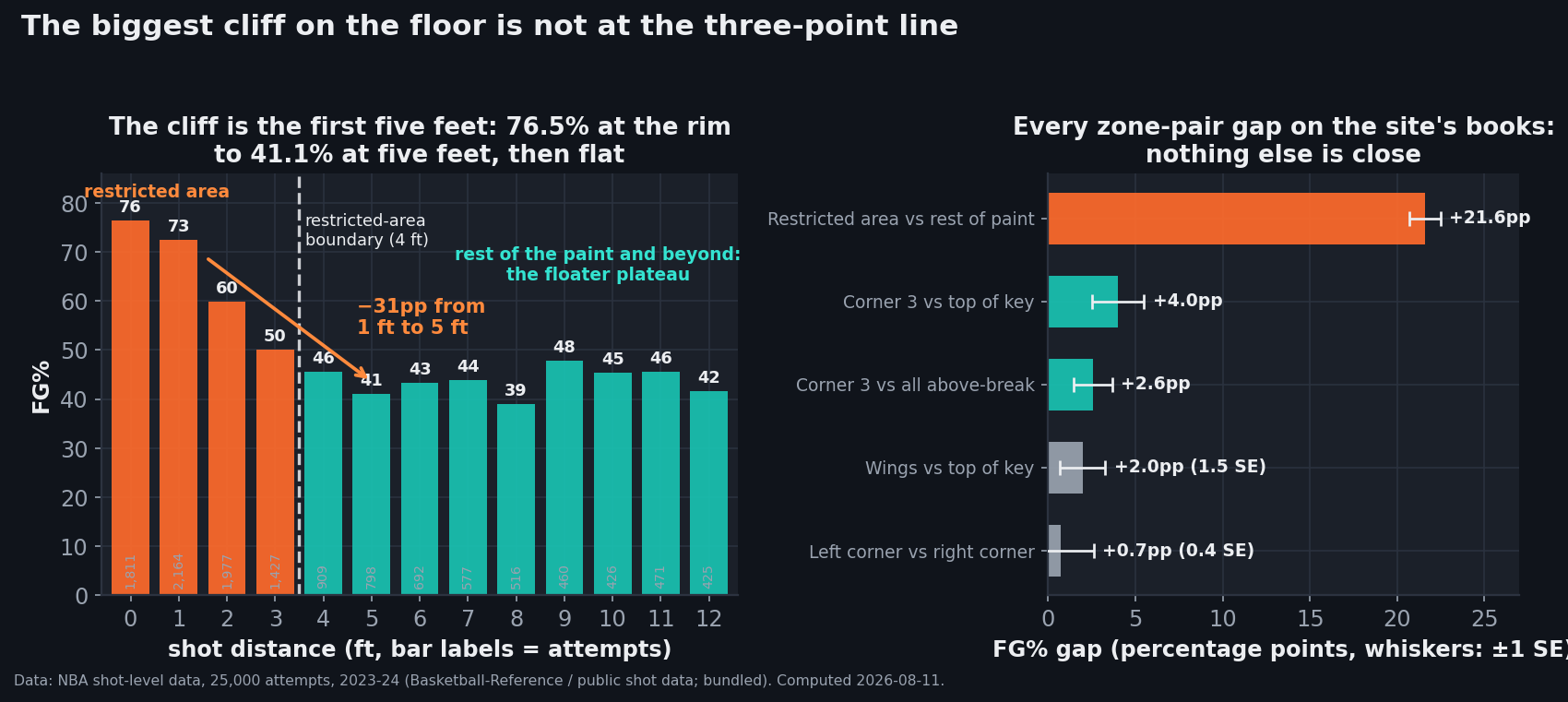
data_layer/nba_league_shots.csv (25,000 attempts, 2023-24; Basketball-Reference / public shot data). Charted by chart_restricted_area_cliff.py with a stamped provenance footer.Read the FG% column down and the cliff announces its address. The fall is steepest immediately: −12.6 points from 1 to 2 feet, −9.8 from 2 to 3, then −4.6 and −4.4 across the boundary feet. From 1 foot to 5 feet, accuracy drops 31.4 points (15.8 SE). And then it simply stops falling. From 5 feet to the arc the floor is a plateau: the 5–12-foot bands pool to 43.2%, all twos from 5 to 21 feet pool to 42.7%, and the band-to-band wobble (39.0% at 8 feet, 47.8% at 9) is what 500-shot bins do — that swing runs 2.8 SE, but it is one of a dozen adjacent-foot comparisons here, exactly the multiple-comparisons terrain the symmetry audit warned about. The distance piece saw the same shape in coarser bands; its 0–2-foot 69.5% and 3–5-foot 46.5% both re-emerge from this file on demand. Between five feet and the arc, an NBA shot is roughly one shot.
Is the boundary itself the cliff?
Honesty requires a refinement, because the zone comparison flatters the boundary. The three-point line is a true step function: cross it and the same shot pays one point more, a discontinuity written in the rulebook. The restricted-area edge is not that. It is the base of a steep, continuous ramp — most of the 21.6-point gap accumulates inside the circle, across feet 1 through 3, not at the painted arc itself. The cleanest boundary-only test is the two adjacent feet that straddle it: 3-foot shots (restricted area) went in at 50.1%, 4-foot shots (non-RA) at 45.5% — +4.6 points, 2.2 SE. The single step across the boundary, one foot of floor, matches the corner-versus-top gap, the largest thing the site ever found at the arc. But the fair summary is that the cliff is the first five feet, and the restricted area is the zone the league drew around its steep section.
A verification note. Recompute each shot's radius from LOC_X/LOC_Y (hoop 5.25 feet from the baseline) and floor(r) matches SHOT_DISTANCE on 99.9% of rows — and the zone tag is geometrically exact: 0.00–4.00 feet of computed radius inside, 4.00–15.80 outside, means 5.9 feet apart. The zones never overlap in distance, which is why their comparison measures the whole ramp rather than the boundary step.
The league table of cliffs
Put every zone-pair gap the site has measured on one scale, recomputed from the same file — each line reproduces its original article's number:
| Gap | Size | ±1 SE | z | First measured |
|---|---|---|---|---|
| Restricted area vs rest of paint | +21.57pp | 0.90 | 24.1 | this piece |
| Corner 3 vs top of the key | +4.02pp | 1.48 | 2.7 | the wing piece |
| Corner 3 vs all above-the-break | +2.56pp | 1.11 | 2.3 | the corner piece |
| Wings vs top of the key | +1.97pp | 1.30 | 1.5 | a lean, not a finding |
| Left corner vs right corner | +0.70pp | 1.92 | 0.4 | nothing — no grain |
The gradient comparison makes the geometry vivid. Across three-point distances, accuracy falls 0.82 points per foot (that recomputes here too); across feet 2 to 5 it falls 6.3 points per foot, eight times as steep. And the cliff wins even in the value currency that made the arc famous. The arc's celebrated jump is +0.33 points per shot (0.81 on the 18–21-foot two, 1.14 on the 22–25-foot three; both reproduce from this file). The restricted-area edge is worth −0.43 points per shot — 1.32 inside, 0.88 outside, about 43 points per 100 attempts. The most consequential few feet on a basketball floor are not at the arc. They are the last few steps of a drive.
What a non-RA paint two actually pays
At 0.88 points per shot, a paint two outside the circle pays less than every three-point zone on the floor — corners at 1.16, wings at 1.09–1.11, even the much-maligned top of the key at 1.04. Run the equivalence the other way: 0.88 a shot is what a three returns at 29.5%, a mark no zone in this file sinks near. A 10-foot floater and a 29.5% three are the same transaction. The restricted area, meanwhile, pays like a 43.8% three — better than the corners actually shoot. So why does the league spend 19.9% of its attempts on the floater zone? Because those shots are not chosen over an open three; they are the concession a defense extracts. Rim protection is, almost by definition, the craft of turning 1.32-point attempts into 0.88-point attempts without fouling, and as the drives piece lays out, a floater is often the residue of a drive the help walled off four feet early. The cliff is why walling off four feet is worth an entire defensive scheme.
The house sidedness check, for the record: non-RA paint splits 251 left side, 4,423 center, 297 right; left 45.4%, right 39.7% — +5.7 points at 1.3 SE on tiny bins. Noise; the floor keeps its no-grain record.
Limitations
The shot mix inside the paint is unobservable. This file carries no action type — no flag for dunk, layup, tip, floater, or push shot. The restricted area's 65.8% blends near-automatic dunks with contested reverse layups; the non-RA zone blends runners with short pull-ups. Some unknown share of the cliff is composition — different shots, not the same shot moved back three feet — and with these columns we cannot split it. Read the cliff as the price of launching from each patch of floor, not the difficulty curve of one shot type.
Blocked shots are in; fouls are not. A blocked layup counts as a missed rim attempt, and rim shots get blocked far more than floaters — yet 65.8% is what survives anyway. Cutting the other way, drives that end in shooting fouls mostly never register an attempt, and free throws live outside this file — the gap true shooting exists to close. Both zones' points-per-shot figures undercount trips that end at the line, the rim's especially.
Selection is doing some lifting. The 65.8% describes the rim attempts players chose to take; the contested ones passed up or stripped never enter the denominator. And this is one bundled 25,000-shot sample of 2023-24 with integer distances — enough to place the cliff between 1 and 5 feet, not enough to map its face in inches.
Reproduce it
The headline is four lines; the chart script prints every number quoted here on each run:
import pandas as pd, numpy as np
df = pd.read_csv("data_layer/nba_league_shots.csv")
df["made"] = df["SHOT_MADE"].astype(bool)

ra  = df[df.BASIC_ZONE == "Restricted Area"]["made"]
nra = df[df.BASIC_ZONE == "In The Paint (Non-RA)"]["made"]
se  = np.sqrt(ra.mean()*(1-ra.mean())/len(ra)
            + nra.mean()*(1-nra.mean())/len(nra))
print(ra.mean() - nra.mean(), se)     # 0.2157, 0.0090 -> z = 24.1

print(df[df.SHOT_DISTANCE <= 12]
      .groupby("SHOT_DISTANCE")["made"].agg(["size", "mean"]))
Sources & method
- Shot-level data: 25,000 records with zone, distance, and outcome, bundled at
data_layer/nba_league_shots.csv(Basketball-Reference / public shot data; sourcing notes indata_layer/SOURCE.txt). This is a sample of the 2023-24 season, not the full league attempt log. All figures computed 2026-08-11 bychart_restricted_area_cliff.py. - Method: paint zones from
BASIC_ZONE; per-foot bands on integerSHOT_DISTANCE, which is floored radial feet (verified againstLOC_X/LOC_Y-derived distance, 99.9% agreement, hoop center 5.25 ft from the baseline). Standard errors are binomial — √(pq/n) per zone, √(p₁q₁/n₁ + p₂q₂/n₂) for differences. PPS = shot value × make rate. - Restricted-area geometry (4-foot radius from the center of the basket): official NBA Rulebook.
- Related on this site: where the NBA actually shoots from · accuracy falls with distance · wing three vs top three · the corner three, measured · rim protection, explained.